Picking the wrong glow plug for a nitro RC engine causes hard starting, an unstable idle, or outright detonation under load. This guide ranks the best glow plugs for nitro RC engines in 2026 by heat range, combustion stability, and the specific job each plug solves — not by which one has the loudest packaging.
Best overall: O.S. Engines No. 8. Best for beginners and break-in: O.S. Engines No. 5. Best for high-nitro racing fuel: Novarossi Turbo. Best for on-road touring cars: Werks Racing Turbo Glow. Best budget option: Trinity Monster Plug.
- O.S. Engines No. 8 is the best overall glow plug for nitro RC engines running standard 16-20% nitro fuel in 2026.
- O.S. Engines No. 5 (hot range) simplifies break-in and cold-weather starting on new nitro engines.
- Novarossi Turbo cold-range plugs resist detonation under 25-30% nitro competition fuel.
- Werks Racing Turbo Glow holds a stable idle transition on high-RPM on-road touring car engines.
- Budget plugs like the Trinity Monster work for casual bashing but wear out faster under repeated heat cycling.
Why this matters
A glow plug's heat range sets how much residual heat stays in the combustion chamber between cycles. Match it to the fuel's nitro percentage and the engine's compression ratio, and the engine starts predictably and holds a clean transition off idle. Get it wrong and you get one of two failure modes: a plug too hot for the fuel pre-ignites and hammers the piston, or a plug too cold for the fuel won't sustain combustion at low RPM.
At Powerbandprecision.com, controlled load testing on the dyno shows the same pattern over and over: engines running a mismatched heat range exhibit erratic compression behavior long before a rebuild becomes obvious to the driver. By the time you notice a rough idle or a flat powerband, piston-to-sleeve wear may already be underway — and that's where a nitro engine rebuild cost conversation starts. A correctly matched glow plug is cheap insurance against that outcome.
What makes the best glow plug for nitro RC engines
- Heat range matched to nitro percentage and compression ratio — the single biggest factor in combustion stability
- Element and coil design — single-coil plugs run simpler, quad-coil (turbo) plugs hold idle better at high RPM
- Fouling resistance under rich mixture conditions — especially during break-in when the needle is set rich
- Consistent idle-to-throttle transition — no bogging or hesitation when you crack the throttle
- Durability across repeated heat cycles — from initial break-in through a full racing season
- Compatibility with turbo glow igniter systems — matters for remote-start setups at the track
Glow plugs at a glance
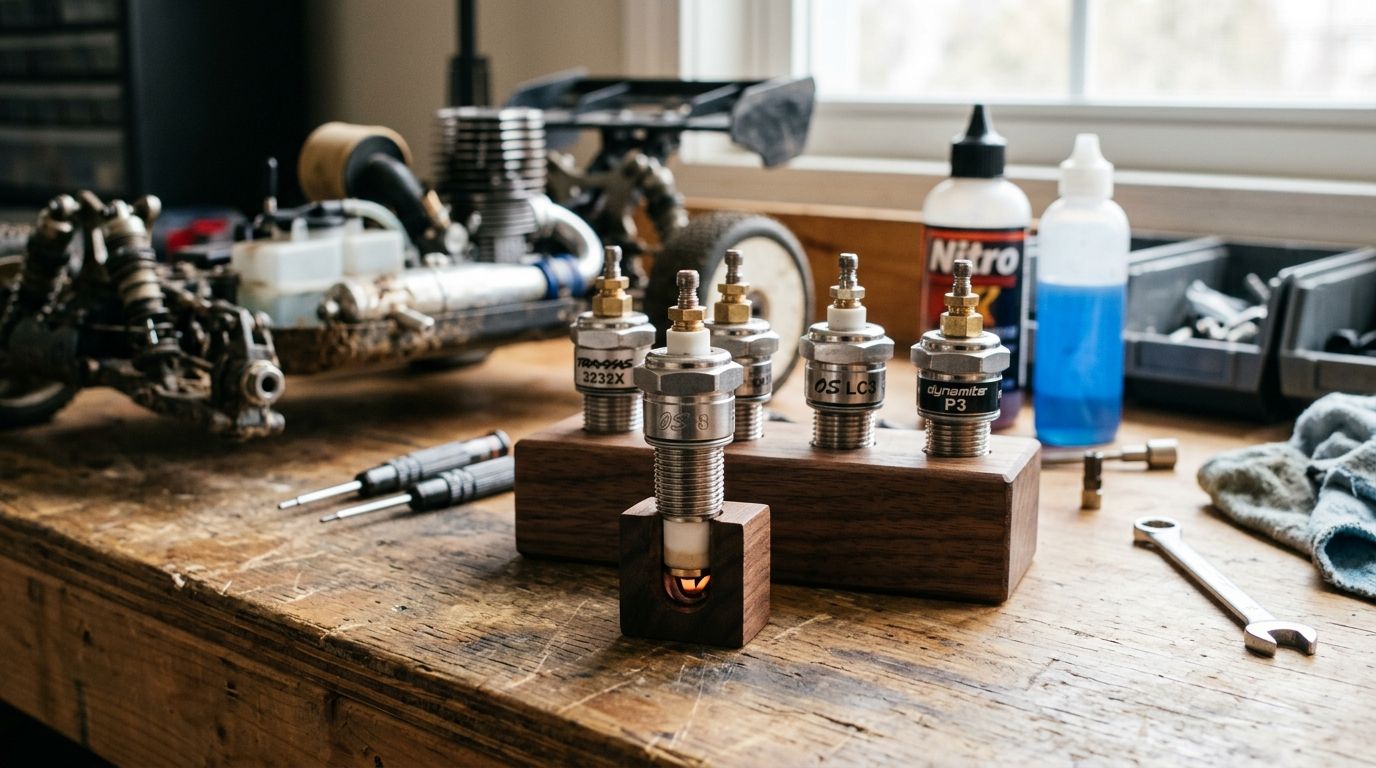
| Glow Plug | Best For | Standout Feature | Key Limitation |
|---|---|---|---|
| O.S. Engines No. 8 | Best overall | Medium heat range works across most .21-.28 displacement engines | Runs hotter than ideal above 20% nitro fuel |
| O.S. Engines No. 5 | Best for beginners and break-in | Hot range simplifies starting during piston-to-sleeve break-in | Too hot for sustained high-RPM racing |
| Novarossi Turbo | Best for high-nitro racing fuel | Cold range resists detonation under 25-30% nitro fuel | Harder to light off in cold ambient temperatures |
| Werks Racing Turbo Glow | Best for on-road touring cars | Quad-coil element holds the idle transition at high RPM | Element fatigues faster under off-road vibration |
| Trinity Monster Plug | Best budget option | Affordable standard-coil design for casual bashing | Shorter service life under repeated heat cycling |
1. O.S. Engines No. 8: best glow plug for nitro RC engines overall
The O.S. Engines No. 8 sits in the medium heat range, which is why it shows up as the factory-recommended plug across most .21 to .28 displacement nitro engines running 16-20% nitro fuel. It handles idle transition cleanly and doesn't foul easily during normal rich-mixture running.
O.S. Engines No. 8 pros:
- Medium heat range fits the widest range of stock nitro engines and fuel blends
- Predictable starting behavior across seasonal temperature swings
- Holds up through multiple break-in cycles without premature element fatigue
O.S. Engines No. 8 cons:
- Not the right choice once you move to high-nitro competition fuel
- No turbo-glow quad-coil variant for remote-start setups
O.S. Engines No. 8 best for: stock and moderately tuned nitro engines running standard pump-grade RC fuel.
Verdict: Buy. This is the default plug for 2026 unless your fuel or engine setup pushes you toward a specific heat range below.
2. O.S. Engines No. 5: best for beginners and engine break-in
The O.S. Engines No. 5 runs a hotter range than the No. 8, which makes cold starts and initial break-in noticeably easier on a brand-new engine. During break-in, the needle is set intentionally rich, and a hotter plug keeps combustion consistent while the piston-to-sleeve mating is still settling in.
O.S. Engines No. 5 pros:
- Easier starting in cold weather and on freshly assembled engines
- More forgiving of rich needle settings during break-in
- Widely available and inexpensive to keep spares on hand
O.S. Engines No. 5 cons:
- Too hot for sustained racing once the engine is broken in and leaned out
- Shorter usable life if left in the engine after break-in is complete
If you're breaking in a new motor for the first time, the best nitro engines for beginners guide covers which engines pair well with a hot-range plug during that phase.
O.S. Engines No. 5 best for: new engine break-in and cold-weather starting.
Verdict: Buy for break-in duty, then swap to a cooler-range plug once the engine is dialed in.
3. Novarossi Turbo: best for high-nitro racing fuel
The Novarossi Turbo runs a cold heat range built for 25-30% nitro competition fuel. Higher nitro content raises combustion temperature on its own, and a cold plug keeps the chamber from pre-igniting before the piston reaches top dead center.
Novarossi Turbo pros:
- Resists detonation under high-nitro racing fuel and aggressive tuning
- Holds a clean powerband characteristic at sustained high RPM
- Popular choice among competition tuners for a reason — it's a known quantity
Novarossi Turbo cons:
- Harder to start in cold ambient conditions or with lower-nitro fuel
- Overkill (and a starting headache) for a casual backyard basher
Novarossi Turbo best for: racers running 25%+ nitro fuel on tuned engines.
Verdict: Buy if you're racing on high-nitro fuel. Skip it for casual bashing on standard 16-20% fuel.
4. Werks Racing Turbo Glow: best for on-road touring cars
On-road touring car engines spin higher and longer than off-road buggy engines, and the Werks Racing Turbo Glow's quad-coil element is built to hold that idle-to-throttle transition without stumbling. It's designed to pair with turbo glow igniter systems for quick pit-lane restarts.
Werks Racing Turbo Glow pros:
- Quad-coil design holds idle transition better at sustained high RPM
- Built for turbo glow igniter compatibility — faster restarts between runs
- Consistent combustion behavior across a race weekend
Werks Racing Turbo Glow cons:
- Costs more per plug than a standard single-coil design
- Vibration from off-road use fatigues the element faster than on smoother on-road surfaces
Werks Racing Turbo Glow best for: touring car and on-road racers running turbo glow igniter systems.
Verdict: Buy for dedicated on-road racing. Hold off if you're strictly running off-road buggies or trucks.
5. Trinity Monster Plug: best budget option
The Trinity Monster Plug uses a standard single-coil design without the racing-specific coating or quad-coil construction of the plugs above it. For a weekend basher who isn't chasing lap times, it starts reliably and costs less to keep as a spare.
Trinity Monster Plug pros:
- Lower cost per plug makes carrying spares easier
- Reliable starting for casual, non-competitive running
- Simple single-coil design with no compatibility quirks
Trinity Monster Plug cons:
- Shorter service life under repeated heat cycling compared to turbo-coil designs
- Not tuned for high-nitro racing fuel or sustained high-RPM use
Trinity Monster Plug best for: casual bashers who replace plugs regularly and don't race competitively.
Verdict: Buy if budget matters more than racing performance. Wait on this one if you're stepping up to competition fuel soon — you'll be replacing it anyway.
Not sure which heat range fits your engine?
Dyno analysis shows compression behavior instead of guesswork.
How we ranked these glow plugs
Ranking weighs heat range accuracy against nitro percentage first, since that's the variable that causes the most detonation and fouling complaints. Element durability across heat cycles, idle-transition behavior, and turbo-glow igniter compatibility follow behind it. Controlled load testing consistently shows that heat range mismatch — not plug brand — is the root cause behind most starting and idle complaints traced back to the glow plug.
Which glow plug should you choose?
Default to the O.S. Engines No. 8 if you're running a stock or mildly tuned nitro engine on standard pump fuel — it's the safest bet for 2026. Swap to the O.S. Engines No. 5 only during break-in or cold starts, then move on. Racing 25%+ nitro fuel pushes you to the Novarossi Turbo; dedicated on-road touring car racers should run the Werks Racing Turbo Glow. If you just need a reliable, inexpensive spare for weekend bashing, the Trinity Monster Plug covers it.
FAQ
What's the best glow plug for nitro RC engines in 2026?
The O.S. Engines No. 8 is the best overall choice for 2026 because its medium heat range works across most stock and moderately tuned nitro engines running 16-20% nitro fuel.
Is a hotter or colder glow plug better for nitro RC cars?
It depends on your fuel's nitro percentage and compression ratio. A hotter plug helps starting and break-in, while a colder plug resists detonation on high-nitro racing fuel.
How often should you replace a nitro RC glow plug?
Replace a glow plug once starting gets noticeably harder or the coil filament shows discoloration or breaks, which happens faster under repeated heat cycling.
Can a bad glow plug cause engine detonation?
Yes. A heat range that's too hot for the fuel and compression ratio can cause pre-ignition, which shows up as detonation under load and accelerates piston-to-sleeve wear.
Does nitro percentage really matter for glow plug heat range?
Yes. Higher nitro content raises combustion temperature on its own, so racing fuel above 25% nitro needs a colder plug than standard 16-20% pump fuel.
Are turbo glow plugs different from standard glow plugs?
Turbo glow plugs use a quad-coil element built to work with remote turbo glow igniter systems and hold idle transition better at high RPM, unlike standard single-coil plugs.
What heat range should a nitro RC buggy run?
Most off-road buggies running stock or moderately tuned engines on standard fuel do well with a medium heat range plug like the O.S. Engines No. 8.
One last thing
Carry at least two heat ranges in your pit box, not one. Ambient temperature swings between a morning practice session and an afternoon race can shift starting behavior enough that the plug that worked at 9 a.m. floods the engine by 2 p.m. — swapping plugs takes thirty seconds; diagnosing a flooded engine mid-heat doesn't.