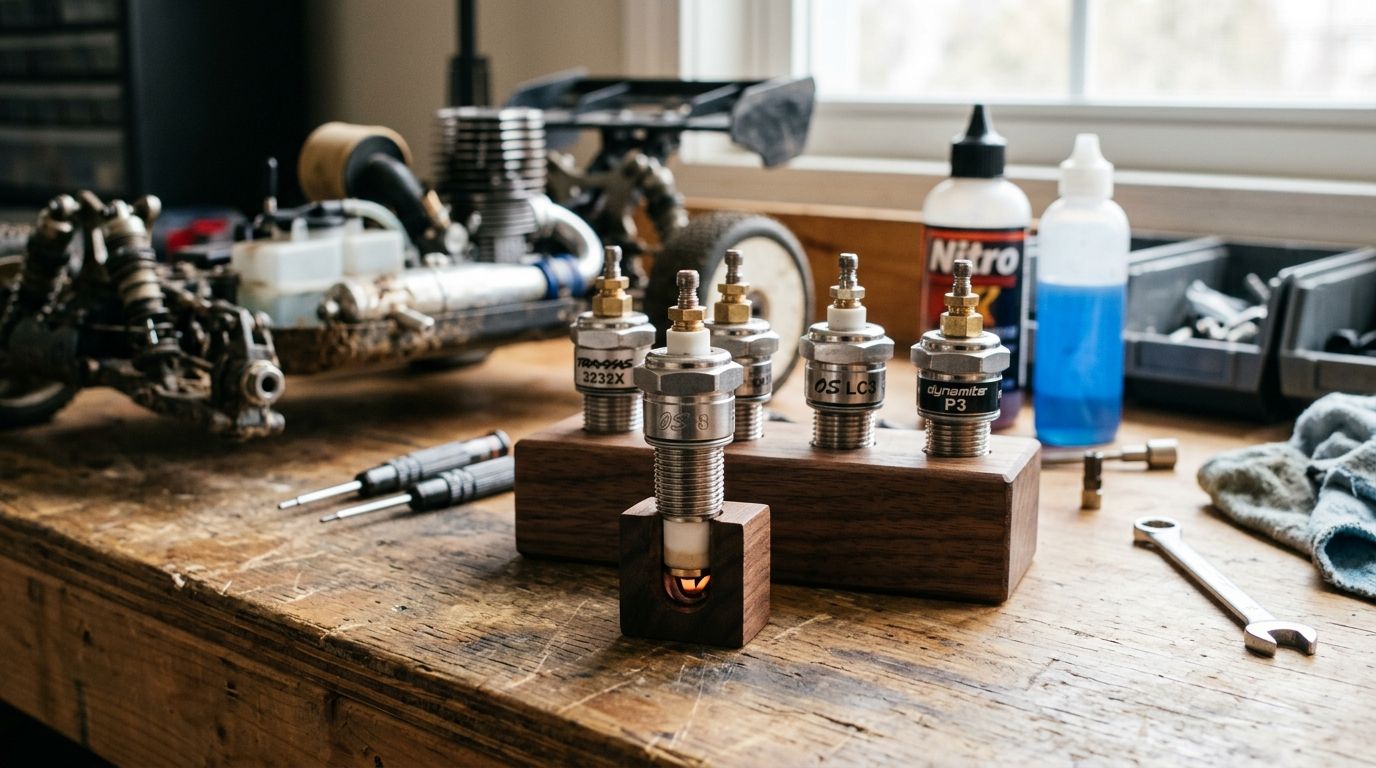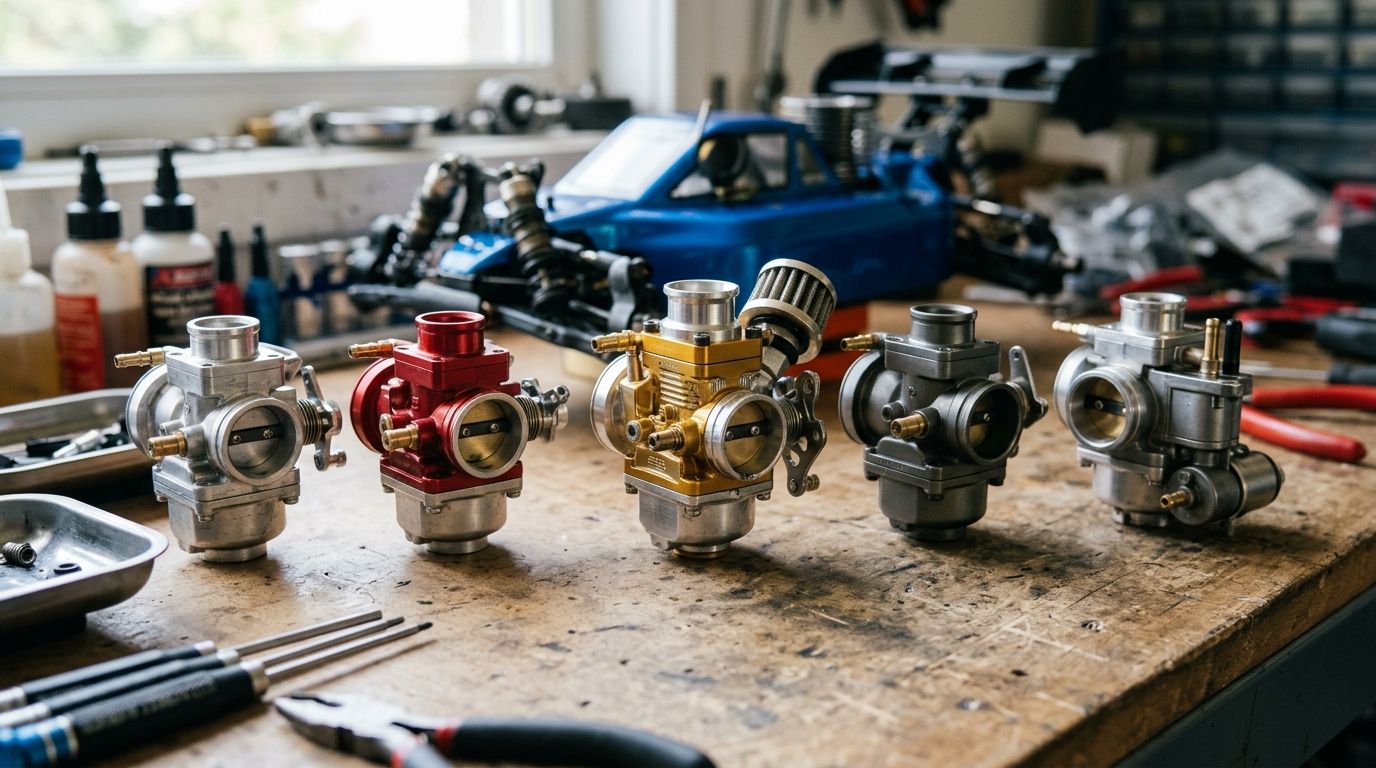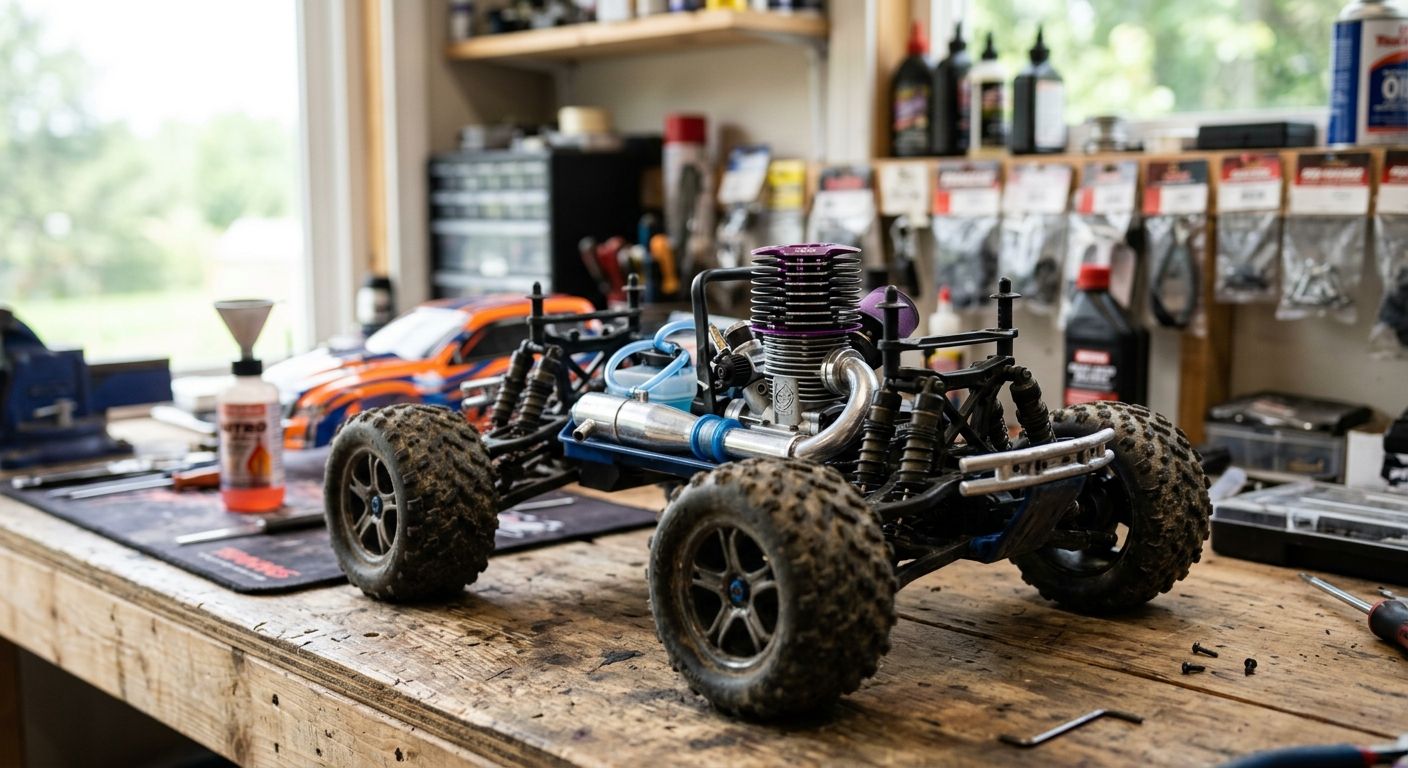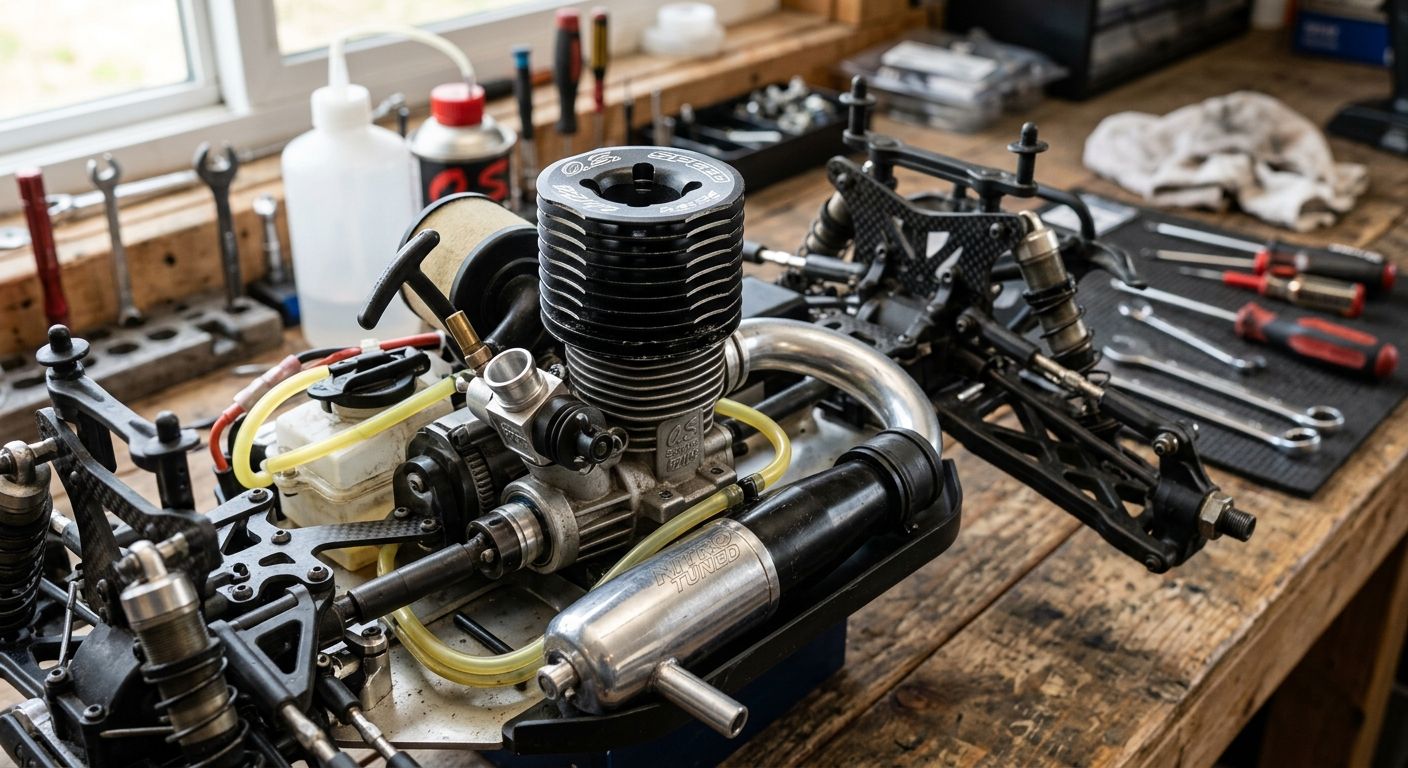
The best nitro RC truck engine in 2026 depends on chassis size and how hard you plan to run it: best overall is an O.S. Engines .21-class engine for 1/10 scale stadium and monster trucks, best for 1/8 scale truggy-based trucks is an O.S. Engines .28/.32-class engine, and best for beginners on factory RTR trucks is a Traxxas-style legacy nitro engine already installed in the vehicle.
- O.S. Engines .21-class wins for most 1/10 scale nitro RC trucks in 2026 on parts support and break-in consistency.
- O.S. Engines .28/.32-class is the pick for 1/8 scale truggy-based trucks that need low-end torque.
- Novarossi and REDS Racing suit competitive racers, not weekend bashers, due to parts lag and tuning demands.
- Traxxas legacy nitro engines still run fine on existing RTR trucks but rebuild support keeps shrinking.
- Displacement class, not brand name, is the single biggest factor in matching an engine to a truck.
Why this matters
Picking a nitro RC truck engine by horsepower claims alone is how most bashers end up with a lean-run piston or a truck that bogs off the line. Displacement class, piston-to-sleeve tolerance, and how the engine was broken in matter more than the number stamped on the case.
Powerband Precision runs controlled load testing on every engine it sells and rebuilds, which is why this ranking leans on measurable compression behavior and powerband character instead of marketing copy. That approach carries into every pick below, including the trucks that aren't O.S. Engines products.
What makes the best nitro RC truck engine
- Displacement fit to chassis weight and tire diameter — undersized engines lug, oversized ones overheat the drivetrain
- Piston-to-sleeve mating tolerance, which determines compression behavior consistency run after run
- Needle-valve carburetor response under load, not just at idle
- Parts and rebuild availability in the U.S. market
- Powerband character — low-end torque versus high-RPM top end
- Compatibility with recoil or pull-start systems already on the chassis
Best nitro RC truck engines at a glance
| Engine | Best For | Standout Feature | Key Limitation |
|---|---|---|---|
| O.S. Engines .21-class | Overall pick, 1/10 scale trucks | Documented break-in procedures, wide U.S. parts support | Less torque for heavier truggy-based trucks |
| O.S. Engines .28/.32-class | 1/8 scale truggy-based trucks | Low-end torque for paddle tires and traction rollers | Adds nose weight, higher fuel draw |
| Novarossi | Competitive racers | Adjustable compression via head shims | Slower U.S. parts turnaround |
| REDS Racing | On-road-derived truck conversions | Tight factory piston-to-sleeve tolerances | Tuned for high RPM, weak low-end torque |
| Traxxas-style RTR engine | Beginners on factory RTR trucks | Simple integration, low entry cost | Discontinued lineup, shrinking rebuild support |
1. O.S. Engines .21-class: best nitro RC truck engine for 1/10 scale rigs
The .21 displacement class is the default size for 1/10 scale nitro stadium and monster trucks, and O.S. Engines builds this class with piston-to-sleeve tolerances that hold compression behavior consistent through repeated heat cycles. Powerband Precision dyno-tests these engines before and after rebuilds, which is how tight tolerances get verified instead of assumed.
O.S. Engines .21-class pros:
- Wide U.S. parts availability for gaskets, bearings, and carburetor rebuild kits
- Documented, repeatable break-in procedure that most tuners already know
- Dyno-verifiable powerband data available through controlled load testing
O.S. Engines .21-class cons:
- Less low-end torque than .28/.32 engines on heavier truggy-based trucks
- Needle-valve tuning still needs careful monitoring through break-in to avoid a lean spike
Best for: 1/10 scale nitro stadium and monster trucks running stock to mild traction setups. Verdict: Buy.
2. O.S. Engines .28/.32-class: best nitro RC truck engine for 1/8 scale truggy-based trucks
Trucks built on 1/8 scale truggy platforms carry more rotating mass and bigger paddle tires, and the .28/.32 displacement class delivers the low-end torque needed to get that mass moving without lugging the engine. The tradeoff is a heavier engine up front and more fuel burned per tank. For a full breakdown of how this class stacks up in off-road buggy platforms, the best nitro RC engines for off-road buggies guide covers the same displacement logic from the buggy side.
O.S. Engines .28/.32-class pros:
- Strong low-end torque for larger paddle tires and traction rollers
- Shares the same O.S. parts ecosystem as the .21-class
- Holds compression behavior under sustained load better than smaller-class engines pushed past their limit
O.S. Engines .28/.32-class cons:
- Adds nose weight that changes handling balance on lighter chassis
- Costs more to rebuild than a .21-class engine — see the nitro engine rebuild cost breakdown for what drives that difference
Best for: 1/8 scale truggy-based trucks that need torque over top-end RPM. Verdict: Buy for truggy conversions.
3. Novarossi: best nitro RC truck engine for competitive racers wanting a tunable powerband
Novarossi has a reputation among ROAR-sanctioned truck racers for precision porting and adjustable compression through head shim options, which lets a tuner shift powerband character without swapping the whole engine. That flexibility comes with a steeper learning curve on break-in than an O.S. Engines .21 or .28/.32.
Novarossi pros:
- Adjustable compression via head shims for fine powerband tuning
- Favored in competitive truck racing classes for consistent top-end pull
- Precision porting reputation among sanctioned racers
Novarossi cons:
- U.S. parts availability lags behind O.S. Engines
- Break-in procedure demands more attention than mainstream .21-class engines
- Rebuild kits run pricier than domestic-supported alternatives
Best for: competitive racers who want a dyno-tunable powerband and don't mind a longer parts wait. Verdict: Hold — good for racers, overkill for bashers.
4. REDS Racing: best nitro RC truck engine for on-road-derived truck conversions
REDS Racing engines come out of on-road racing, where high-RPM stability matters more than low-end torque, and that factory tuning carries over into truck conversions built for speed over crawling ability. Piston-to-sleeve tolerances arrive tight from the factory, which shows up as strong resale value among racers moving between platforms.
REDS Racing pros:
- Tight factory piston-to-sleeve tolerances
- Strong high-RPM stability
- Solid resale value among racers
REDS Racing cons:
- Low-end torque suffers on heavier trucks not built for on-road speed
- Imported parts mean a longer wait for rebuild kits in the U.S.
Best for: on-road-derived truck conversions built for speed rather than traction. Verdict: Hold — better suited to on-road-style trucks than bashing rigs.
5. Traxxas-style RTR engine: best nitro RC truck engine for beginners
Beginners running a factory RTR nitro truck already have an engine installed, and for most of these trucks it's a legacy Traxxas-style design built for simple integration rather than tunability. It's a fine starting point in 2026 for someone learning glow-plug basics before moving to an aftermarket .21-class engine. The best nitro RC engines for beginners guide walks through when that upgrade actually makes sense.
Traxxas-style RTR engine pros:
- Simple integration with the factory RTR truck it came with
- Low cost of entry into nitro for a first-time owner
- No aftermarket tuning knowledge required to get running
Traxxas-style RTR engine cons:
- Traxxas discontinued its nitro truck engine lineup, so parts and rebuild support keep shrinking
- Limited tunability compared to aftermarket .21-class engines
Best for: beginners running an existing factory RTR nitro truck. Verdict: Wait — fine for existing RTR owners, skip for new builds.
How we ranked these nitro RC truck engines
Every engine above gets judged against the same six criteria: displacement fit, piston-to-sleeve tolerance, needle-valve response under load, parts availability, powerband character, and starter compatibility. None of the rankings come from horsepower claims alone, because horsepower on a spec sheet doesn't tell you how an engine behaves at 40% throttle on a rutted track.
Durability under sustained torque is the other half of this equation, especially for .28/.32-class engines pushed hard on truggy conversions. The crankshaft is usually the first component to show fatigue under that kind of repeated load, and choosing a billet crankshaft matters more for torque-heavy truck use than it does for a lighter on-road build. That single component swap changes the failure point of an otherwise well-tuned engine.
“If the needle valve needs babysitting after break-in, the engine wasn't broken in on load — it was broken in on hope.”
Which nitro RC truck engine should you choose?
For most nitro RC trucks running in 2026, the O.S. Engines .21-class is the default pick — it's the best-supported displacement class in the U.S. and the easiest to verify through dyno testing. Step up to the .28/.32-class only if the chassis is a 1/8 scale truggy conversion carrying real traction load. Novarossi and REDS Racing belong on a race truck with a dedicated tuner, not a weekend basher, and a Traxxas-style legacy engine is fine to run out until it needs a rebuild it can't easily get.
Get your truck engine dyno-verified
Controlled load testing shows compression behavior before you commit to a rebuild.
FAQ
What's the best nitro RC truck engine for beginners?
For most beginners, the factory-installed engine on an RTR nitro truck is the right starting point in 2026, since it removes the tuning learning curve. Once break-in basics are solid, an O.S. Engines .21-class engine is the natural upgrade path.
Is a .21 or .28 engine better for a nitro RC truck?
A .21-class engine is better for 1/10 scale stadium and monster trucks, while a .28 or .32-class engine suits 1/8 scale truggy-based trucks needing more low-end torque. Matching displacement to chassis weight matters more than brand name.
How much does a nitro RC engine rebuild cost?
Rebuild cost depends on displacement class and how far compression behavior has drifted from spec, with .28/.32-class engines generally running higher than .21-class rebuilds. The full cost breakdown covers what drives that difference by component.
Are Novarossi engines better than O.S. Engines for trucks?
Novarossi engines offer more compression tuning flexibility through head shims, which suits competitive racers. O.S. Engines wins on U.S. parts availability and rebuild support for everyday truck use.
Do Traxxas nitro trucks still use rebuildable engines?
Yes, legacy Traxxas nitro truck engines are still rebuildable in 2026, but Traxxas discontinued the nitro truck engine lineup, so parts support keeps shrinking over time.
How often should a nitro truck engine be rebuilt?
Rebuild timing depends on run hours and how the engine was broken in, not a fixed calendar interval. A dyno check on compression behavior is the reliable way to know if a rebuild is due.
What size nitro engine fits a 1/8 scale truck?
1/8 scale trucks built on truggy platforms typically run .28 or .32-class engines for the torque needed to move larger paddle tires. Smaller .21-class engines tend to lug on this size chassis.
Can I dyno-tune a nitro RC truck engine myself?
Basic needle-valve tuning is doable at home, but controlled load testing that measures compression behavior across the RPM range requires dyno equipment most hobbyists don't own. That's the gap a dedicated dyno service fills.
One last thing
Most piston-to-sleeve issues on nitro RC truck engines trace back to how the engine was broken in, not a manufacturing defect — a rushed break-in on a brand-new O.S. Engines .21 will show the same lean-run damage a cheap engine shows, just later. Slow down the break-in, watch compression behavior instead of guessing at needle position, and the engine class you picked matters a lot less than how it was treated in the first hour.