Nitro RC engine tuning lives or dies on measurement, not feel — and in 2026 the gap between guys who guess and guys who measure is wider than ever. Best overall: Powerband Precision's controlled dyno analysis. Best for at-track tuning: a digital tachometer. Best budget option: a glow igniter/driver. Everything else on this list fills a specific gap between those three.
- Powerband Precision's dyno analysis is the best nitro RC engine tuning tool for isolating why a tune still underperforms in 2026.
- A digital tachometer is the most-used trackside tool for daily needle valve adjustments.
- An infrared pyrometer catches detonation risk before it wrecks a piston, not after.
- A glow igniter/driver is the cheapest tool on this list and the one most people skip until a plug fails mid-heat.
- A compression tester and a feeler gauge/caliper set separate a mechanical problem from a tuning problem before a rebuild.
Why this matters
Most nitro RC tuning problems get blamed on the needle valve when the real cause is a worn sleeve, a weak glow plug, or a head temperature nobody checked. Tools don't fix engines — they tell you which variable actually moved. A tachometer tells you RPM changed; it doesn't tell you whether that's fuel delivery, compression, or plug heat range. That's the distinction this list is built around: each tool below owns one job, and stacking the right three or four gets you closer to a repeatable tune than any single gadget will.
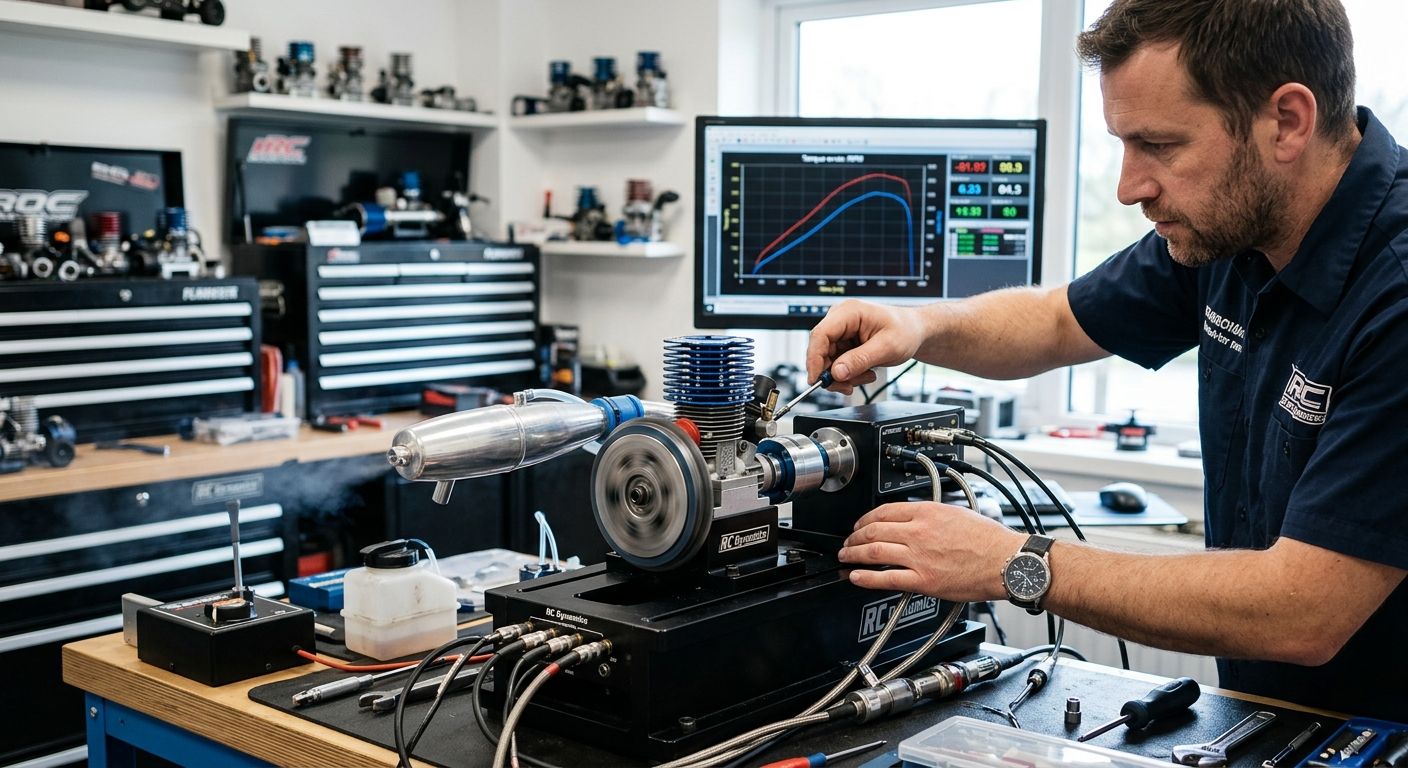
Powerband Precision runs controlled dyno analysis out of Sanger, California, building actual power and torque curves instead of guessing off exhaust note and RPM sound. That data-first approach is the lens for the rest of this ranking.
What makes the best nitro RC engine tuning tool
- Measurement accuracy — reads a real number, not a feel
- Repeatability — gives the same answer twice under the same conditions
- At-track usability — works between heats, not just in a shop
- Compatibility — handles the common .12 to .28 displacement range hobbyists run
- Diagnostic isolation — tells you which variable moved, not just that something changed
- Durability — survives fuel, dust, and glow-plug heat without drifting out of calibration
Nitro RC engine tuning tools at a glance
| Tool | Best for | Standout feature | Key limitation |
|---|---|---|---|
| Dyno analysis (Powerband Precision) | Diagnosing why a tune underperforms | Full power/torque curve, not a single number | Not usable trackside between rounds |
| Digital tachometer | Daily needle valve tuning | Instant RPM feedback | Doesn't explain why RPM is off |
| Infrared pyrometer | Head temperature monitoring | Non-contact reading in seconds | Sensitive to ambient airflow |
| Glow igniter/driver | Plug testing and starting | Confirms plug element health | Says nothing about engine tune |
| Compression tester | Diagnosing wear vs. tune | Isolates mechanical vs. fuel-delivery causes | No single "correct" number across brands |
| Feeler gauge & digital caliper set | Rebuild-time piston-to-sleeve checks | Catches out-of-spec parts before install | Only useful during teardown |
1. Dyno analysis: best nitro RC engine tuning tool for diagnosing powerband problems
Controlled load testing puts the engine under measured resistance across its full RPM range instead of relying on sound and gut feel. The output is an actual power and torque curve, which shows exactly where compression behavior or fuel delivery falls apart — something no handheld tool at the track can isolate.
Dyno analysis pros:
- Produces a documented before-and-after curve for rebuild comparisons
- Isolates whether a flat spot is fuel, compression, or plug-related
- Catches issues that sound fine on track but cost real horsepower
- Gives a baseline to measure every future tune against
Dyno analysis cons:
- Requires dropping off or shipping the engine rather than diagnosing between rounds
- Doesn't replace the day-to-day needle adjustments a driver makes at the track
Best for: pinpointing why a properly tuned-sounding engine still underperforms. Verdict: Buy — schedule one before a rebuild decision, not after.
2. Digital tachometer: best nitro RC engine tuning tool for at-track needle valve tuning
An optical or magnetic tachometer reads peak RPM in seconds, which is the fastest way to catch a needle valve set too rich or too lean between rounds. It's the tool most racers reach for first, and for good reason — it's the only one on this list built for use in the pits.
Digital tachometer pros:
- Instant feedback between heats
- Works across common .12 to .28 nitro engine sizes
- Cheap enough to keep in every pit box
- No warm-up or calibration routine needed
Digital tachometer cons:
- Doesn't explain why RPM shifted — fuel, compression, and plug heat all move the number
- Optical sensors foul with dust and glow-plug residue
Best for: everyday pit-side needle adjustments. Verdict: Buy.
3. Infrared pyrometer: best nitro RC engine tuning tool for detonation prevention
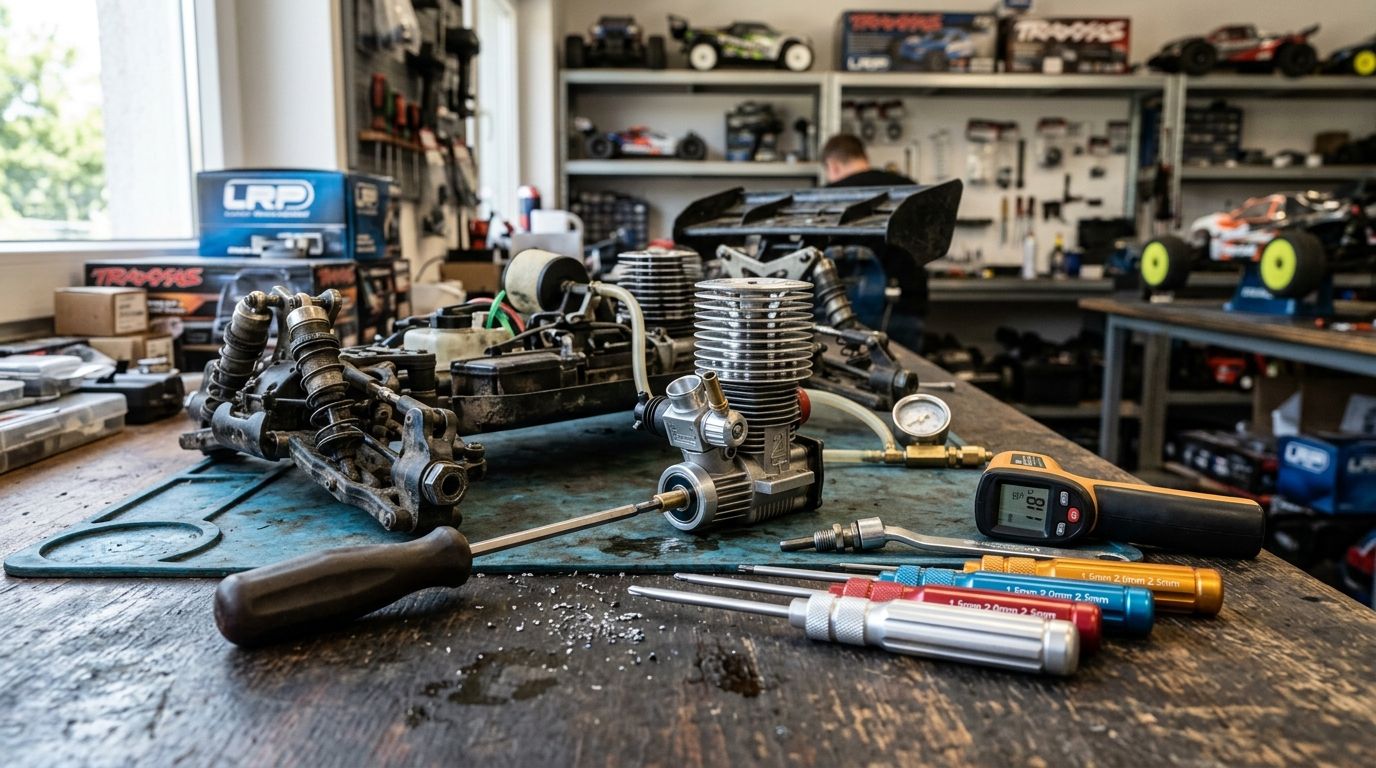
A non-contact infrared temperature gun reads cylinder head temperature in under two seconds, which matters because nitro engines generally run best in the 220-260°F head temperature range — push much past that and detonation risk climbs fast. This is the tool that catches an over-lean needle setting before it costs you a piston.
Infrared pyrometer pros:
- Reads instantly without touching the engine
- Correlates directly to needle setting and glow plug heat range
- Cheap insurance against detonation damage
Infrared pyrometer cons:
- Ambient temperature and airflow shift the reading run to run
- Measures surface temp only, not internal cylinder pressure
Best for: preventing detonation on hot race days. Verdict: Buy.
“If the head temperature climbs past 260°F, back off the needle before you back off the throttle.”
4. Glow igniter/driver: best budget nitro RC engine tuning tool for plug testing
A glow igniter applies current to the plug element to confirm it's still glowing evenly before you blame the tune for a starting problem. It's the least expensive item on this list and the one most hobbyists forget to check first.
Glow igniter pros:
- Confirms plug element health in seconds
- Essential before every start, not just for troubleshooting
- Low cost relative to every other tool here
Glow igniter cons:
- Says nothing about the actual tune quality
- A weak battery gives a false "good plug" reading
Best for: ruling out a dead plug before touching the needle. Pairing this with the right glow plug choice for the engine solves more "bad tune" complaints than any needle adjustment does. Verdict: Buy.
5. Compression tester: best nitro RC engine tuning tool for separating wear from tune
A compression tester tells you whether a stubborn tuning problem is actually a worn ring, a scored sleeve, or a bad seat — mechanical issues that no amount of needle adjustment fixes. Nitro engines don't have one universal "correct" number the way small gas engines do, so this tool works best as a before/after comparison rather than a single absolute reading.
Compression tester pros:
- Isolates mechanical wear from fuel-delivery or carburetor issues
- Useful before committing to a full rebuild
- Reusable across every engine in a fleet
Compression tester cons:
- No single target number across brands and sizes
- Hard to interpret without a baseline reading from when the engine was fresh
Best for: deciding whether a persistent tuning headache is actually a mechanical problem. Carburetor wear shows up here too — worth checking against how nitro RC carburetors compare before assuming the sleeve is the culprit. Verdict: Hold — use it to confirm suspicion, not as a first diagnostic.
6. Feeler gauge & digital caliper set: best nitro RC engine tuning tool for rebuild measurements
During a rebuild, a feeler gauge and digital caliper set is how piston-to-sleeve mating actually gets verified instead of assumed. Replacement pistons and sleeves vary enough between batches that skipping this step is how a fresh rebuild ends up running worse than the old engine.
Feeler gauge & caliper pros:
- Catches an out-of-spec replacement part before installation
- Cheap and reusable across every future rebuild
- Confirms clearance rather than trusting the part number
Feeler gauge & caliper cons:
- Only useful during teardown, not while the engine is running
- Requires a factory spec sheet to know what number you're chasing
Best for: home rebuilders checking new parts before final assembly. Verdict: Buy — cheap enough that skipping it makes no sense.
How we ranked these
Each tool was scored against the six criteria above, weighted toward diagnostic isolation and repeatability over raw convenience. Dyno analysis ranks first because it's the only method that produces a full curve rather than a single number; the tachometer and pyrometer rank next because they're the tools actually used trackside in 2026; the glow igniter, compression tester, and caliper set round out the list as the tools that catch problems the first three can't see.
Get a measured baseline on your engine
Controlled dyno analysis shows exactly where your tune or your rebuild stands.
Which nitro RC engine tuning tool should you choose?
If you're troubleshooting a mystery power loss, book a dyno analysis first — it's the only tool here that shows the full curve instead of one data point. If you're tuning at the track every weekend, a tachometer and pyrometer belong in every pit box, full stop. If your budget only stretches to one purchase this season, the glow igniter/driver rules out the most common false diagnosis before you touch anything else. Everything else on this list earns its spot at rebuild time, not race day.
FAQ
What's the best nitro RC engine tuning tool overall in 2026?
Controlled dyno analysis is the best overall tool because it produces a full power and torque curve instead of a single data point. For daily trackside adjustments, a digital tachometer paired with an infrared pyrometer covers most tuning needs.
Do I need a digital tachometer to tune a nitro RC engine?
Yes, practically speaking. It's the fastest way to confirm a needle valve change moved peak RPM in the right direction between rounds, and most racers keep one in the pit box permanently.
What temperature is too hot for a nitro RC engine head?
Most nitro engines run best with head temperatures between 220°F and 260°F. Readings climbing past that range raise detonation risk and call for backing off the needle rather than the throttle.
Can a compression tester diagnose a bad nitro RC engine tune?
A compression tester diagnoses mechanical wear, not tuning quality. Use it to rule out a worn ring or scored sleeve when needle adjustments stop improving performance.
Is a glow igniter the same as a glow driver?
Yes, the terms are used interchangeably for the tool that applies current to test and start a glow plug. It's the cheapest item on this list and the first thing to check before blaming a tune.
How do I know if my nitro RC engine needs a rebuild instead of a tune?
If a compression check and dyno analysis both point to mechanical wear rather than fuel delivery, a rebuild is the next step. Rebuild scope and typical costs are broken down on the nitro RC engine rebuild cost page.
What's the difference between trackside tuning and dyno tuning?
Trackside tuning adjusts the needle by feel and RPM in real conditions between runs. Dyno tuning measures the full power curve under controlled load, isolating exactly which variable is limiting performance.
One last thing
Most hobbyists own a tachometer and skip the pyrometer entirely — backwards priorities, since detonation from an over-lean setting destroys a piston in seconds while a slow RPM reading just costs a lap. Performance is measured, not guessed: check head temperature as often as you check RPM in 2026, and a lot of "mystery" engine failures stop being mysteries.